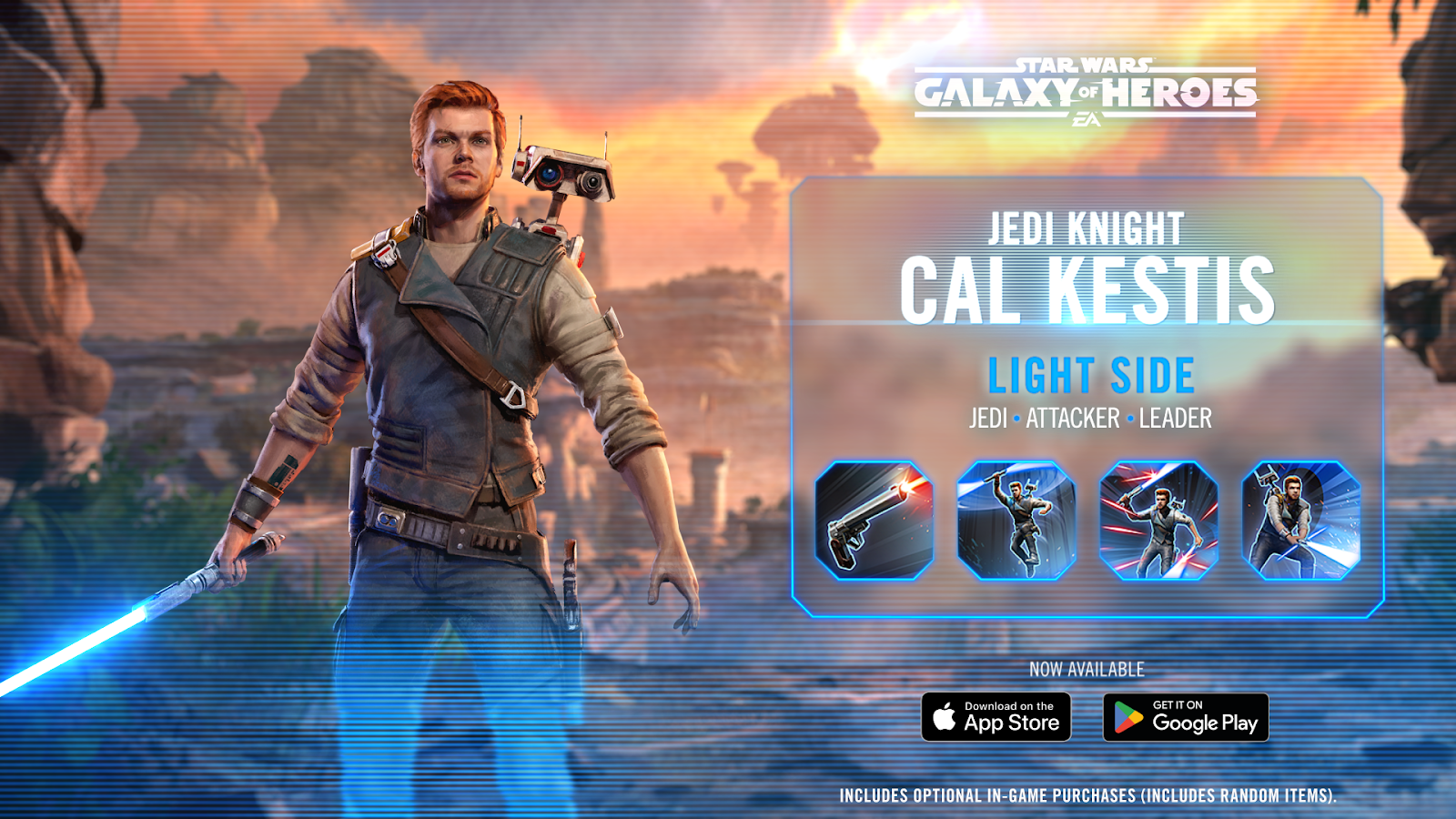
I designed Jedi Knight Cal Kestis to add a faster, more tactical rhythm to Jedi teams without increasing their overall power ceiling.
His loop centers on Impetuous, a stance sequence that lets him take faster turns and build toward Crossguard without disrupting expected turn order or creating a dominant single button.
I owned kit concepting, implementation, loop structure, tuning levers, pacing targets, iteration with QA, and meta-fit evaluation.
We worked under tight constraints: no new engineering support, limited early reference material, and a faction already near the top of the meta.
The final design shipped on schedule with strong player sentiment and stable live performance.
Create a Journey Guide character to align with Jedi: Survivor's launch that would excite players while maintaining delicate game balance.
Cal needed to be exactly as powerful as the strongest non-Galactic Legend Jedi
Target power band: competitive with top Jedi, below Galactic Legends
Too complex for animation, readability, and sustainable tuning. The added stance states created pacing ambiguity and exceeded what we could support within existing tools.
Consolidating to three stances locked in the core Impetuous rhythm, reduced implementation risk, and made the loop easier to tune and teach.
Early versions let Cal unlock Crossguard too quickly, which pushed him toward unwanted snowball patterns.
I anchored the payoff to roughly three of Cal's own turns so the intended stance cycle was also the optimal play pattern.
Players can still force an early spike through heavy external support, but the opportunity cost across other top-tier squads keeps that behavior self-limiting in the wider metagame.
Since Cal was meant to slot into a wide range of Jedi squads, I evaluated his loop across multiple top-tier compositions (JML-, JKL-, and JKR-led teams) and several PvP modes, with and without Omicrons.
This surfaced specific comps whose assist density or acceleration tools let him reach payoff windows too early.
I tuned stack progression and payoff breakpoints accordingly to keep his stance cycle stable while preserving his intended flexibility across the faction.
Success Criteria
Outcomes
Cal's kit revolves around a clear turn-to-turn rhythm:
| Character Type | Typical Flow |
|---|---|
| Standard Jedi | Use any ability → Wait for next turn |
| Jedi Knight Cal Kestis | Use basic (forced) → Gain bonus turn → Use stance ability (special) → Build or spend a few Impetuous stacks → Wait for next turn |
The loop oscillates in a 25–30 band, with players choosing when to spend stacks with Crossguard for burst damage or instant defeat.
Cal plays at a higher tempo than most Jedi because his basic reliably leads into a bonus turn that lets him access a stance ability immediately.
This gives him a responsive, agile feel without disrupting expected turn order.
Using Crossguard lowers his Impetuous stacks slightly, which prevents it from overtaking his other abilities and helps maintain a healthy stance rotation across the typical 5–6 turns a character gets in a match.

Cal's basic ability opens every sequence. It dispels buffs and immediately grants him a bonus turn, setting up access to his stance abilities. This forced opener defines the rhythm: basic for setup, stance for payoff.
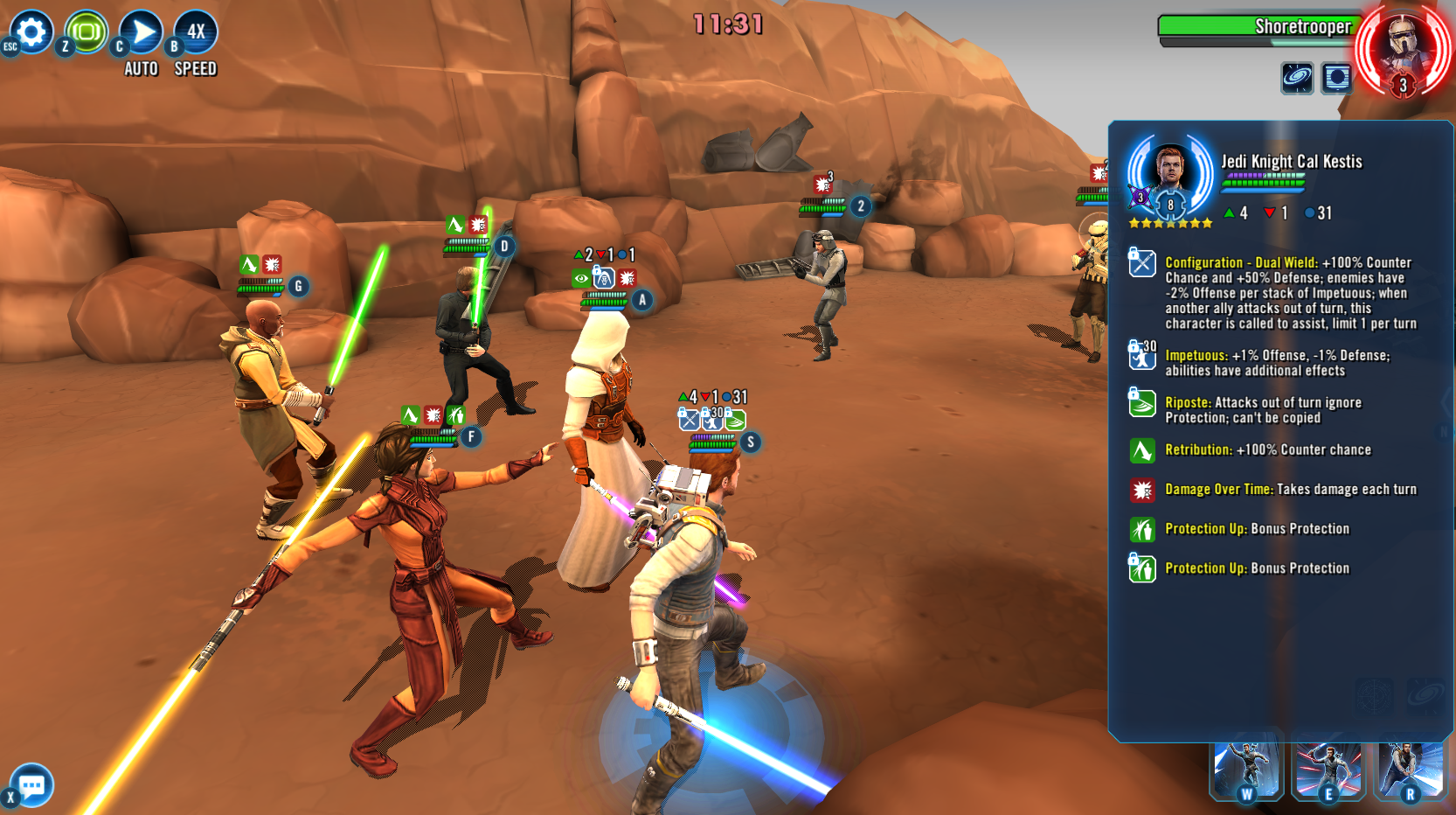



UI communicates stance state and stack count clearly, so players learn pacing feedback visually
The system revealed emergent gameplay that rewarded mastery:
Player sentiment remained positive while usage stabilized within target range
"For me, Jedi Cal Kestis is my favorite character of 2023. I'm using him in every single game mode... he ended the Darth Malgus reign. It reminds me of the good old days of Galaxy - you just put a bunch of random stuff together and kick butt."
Action economy can be tuned like damage or health. Cal proved that adjusting when players act can reshape combat feel without raising overall power.
Working with no new tech forced creative use of existing buff logic, leading to a stance system that felt new while staying within live-ops limits.
The most successful mechanics rewarded understanding and rhythm, not raw stats. Players connected because they could learn the loop.
By matching Jedi power curves but increasing tempo, Cal felt strong without destabilizing the meta. That perception became the real win.
Even strong designs can be overshadowed by release timing or other content beats. Measuring impact means weighing sentiment and engagement, not just metrics.